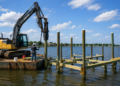
Every strong waterfront structure begins below the visible deck, wall, or walkway. Piles transfer load into the ground or bottom layer and help keep piers, docks, boardwalks, and bulkheads stable in changing waterfront conditions. Without the right pile system, even a well-built surface structure can shift, settle, lean, or become unsafe over time.
Professional piling installation is especially important for projects near lakes, rivers, coastal areas, canals, marinas, and private waterfront properties. The pile type, depth, spacing, and installation method must match the structure being supported, the soil below it, and the water conditions around the site.
Piles are not a decorative detail. They are structural supports that carry loads from docks, piers, boat lifts, boardwalks, bulkheads, and shoreline reinforcement systems. If they are not installed deeply enough or if the wrong material is selected, the structure above them can lose alignment, become unstable, or require early repair.
A good piling plan considers both the immediate project and the future use of the waterfront. A private dock with light foot traffic does not place the same demands on the support system as a commercial marina, large boat lift, heavy pier, or shoreline structure exposed to strong water movement.
Why piles matter in marine construction
Waterfront construction creates load paths that are different from ordinary land-based construction. The structure must handle weight from above, moisture from below, lateral movement from waves or wake, and changing soil conditions. Piles help transfer these forces into a deeper bearing layer.
For docks and piers, piles support the deck framing and help keep the walking surface steady. For boardwalks, piles may be needed where the path crosses soft ground, wet soil, or areas that cannot support a surface directly. For bulkheads and shoreline structures, piles help resist pressure from soil and water.
Proper pile support also helps preserve the usability of the waterfront. When piles are undersized, poorly aligned, or installed in weak soil without enough penetration, the structure may begin to move. That movement can create uneven decking, loose connections, damaged framing, and unsafe access to the water.
- Load transfer — piles carry the weight of the structure into deeper soil or bearing layers instead of relying only on weak surface material.
- Waterfront stability — correctly installed piles help docks, piers, and boardwalks remain usable despite moisture, waves, and changing water levels.
- Structural alignment — proper spacing and vertical accuracy help the upper framing stay straight and reduce stress on connections.
- Long-term support — a pile system designed for the site can reduce repeated repairs caused by settlement, movement, or weak foundations.
Where piling installation is used
Piling installation supports many types of waterfront structures. The same basic purpose is always present — provide strong support below the visible structure — but the design changes depending on the project.
For private piers and docks, piles support walking surfaces, seating areas, boat access points, ladders, and light marine equipment. These projects often require careful spacing so the structure feels stable without unnecessary overbuilding.
For boardwalks, piles can create a raised path over soft ground, shoreline slopes, or wet areas. This helps reduce direct foot traffic on unstable soil while creating safe movement along the waterfront.
For bulkheads and shoreline reinforcement, piles may help anchor or support the wall system. The pile design should match the wall height, soil pressure, water exposure, and expected load behind the shoreline.
- Private docks — piles support deck framing, boat access areas, ladders, and everyday residential waterfront use.
- Piers — pile foundations help extend a stable structure over the water for fishing, access, viewing, or boat support.
- Boardwalks — piles raise the walking surface above soft or wet ground while protecting the shoreline from repeated foot traffic.
- Bulkheads — piles help support soil-retaining structures and improve stability along the waterfront edge.
- Boat lifts and marina structures — heavier loads may require stronger pile types, deeper penetration, and more careful spacing.
Choosing the right pile type
Pile type should be selected according to load, soil, water exposure, and structure type. A material that works well for a private dock on a freshwater lake may not be the correct option for a coastal commercial marina or a shoreline reinforcement project in a saltwater area.
Wood piles are often used for private piers and docks, especially where the owner wants a natural look and practical support for residential structures. Proper treatment and installation are important because the piles are exposed to water and outdoor conditions.
Steel H-piles are used when higher load-bearing capacity is needed. They can be appropriate for heavy piers, commercial marinas, boat lifts, and other structures that place greater demands on the foundation system.
Helical piles are installed by screwing them into the ground. They can be useful for sensitive soils or sites where impact methods may not be suitable near existing structures. Concrete supports are used where maximum strength and durability are needed, especially in demanding coastal or aggressive environments.
What affects pile depth and spacing
Pile depth is not chosen randomly. It depends on water depth, soil bearing capacity, structure load, and the need to reach a stable layer. Shallow water may need shorter piles, while deeper coastal areas may require longer penetration to reach reliable support.
Soil conditions are one of the biggest factors. Sandy and silty soils may be easier to drive through than dense clay or rock. Weak soil may require deeper piles, while stronger soil may allow a shorter design. Bedrock may require pre-drilling or a different installation approach.
Spacing also depends on the structure. A light private dock may need fewer piles than a commercial marina or large boat lift. If piles are spaced too far apart, the framing above can flex or feel unstable. If they are placed without a clear plan, the structure may be harder to build and maintain.
The installation method also matters. Hydraulic hammers, vibro-drivers, and drilling rigs are used in different conditions. The method should match the soil, structure, access, and surrounding environment.
Planning piling installation before construction starts
The best time to plan piling is before the visible structure is designed in detail. Pile location affects framing, decking, hardware, access points, boat lift placement, and the way the structure connects to land. If piling is treated as an afterthought, the project can become harder to build correctly.
Site access should also be reviewed early. Working from shore may be simpler than working from the water, but not every property allows easy equipment access. Narrow residential lots, soft ground, landscaping, steep slopes, or existing structures can change the construction plan.
For waterfront owners, piling installation should be viewed as the foundation of the entire project. The piles may not be the most visible part, but they determine whether the dock, pier, boardwalk, or bulkhead has the support it needs.
A well-planned pile system helps the finished waterfront structure feel solid, perform better, and remain useful for everyday access, boating, shoreline protection, and long-term property value.